
Dholera Is No Longer a Promise: Rail, Semiconductor, Airport & Infrastructure Are Turning Vision into Reality
Introduction
For years, Dholera existed mostly in PowerPoint decks and government press releases.
But in the span of the last few weeks, three things happened that changed the nature of the conversation and they happened almost simultaneously.
A rail corridor got Cabinet clearance.
A Dutch chip giant signed an MoU on foreign soil, in the presence of two prime ministers.
And India's first commercial semiconductor fab moved one step closer to turning out its first chip by December 2026.
If you've been watching Dholera from a distance, now is the time to pay close attention.
Here's what actually happened stripped of the hype, but honest about the scale.
Key Numbers at a Glance
- ₹20,667 Cr – Namo Bharat Rail Corridor (Cabinet-approved, May 2026)
- $11 Billion – Tata Electronics semiconductor fab total investment
- 134 km – Ahmedabad–Dholera rail corridor length
- ₹610 Cr – Gujarat Budget 2026 trunk infrastructure outlay
1. A Train That Changes the Math
On May 13, 2026, the Cabinet Committee on Economic Affairs chaired by Prime Minister Modi formally approved the Ahmedabad–Dholera Semi High-Speed Rail Corridor.
The project, budgeted at ₹20,667 crore, is India's first indigenously developed broad-gauge semi high-speed railway.
It's also, quietly, one of the most consequential infrastructure decisions Dholera has ever received.
The corridor will run 134 kilometres from Sarkhej in Ahmedabad to Dholera SIR on a double-line broad-gauge track, equipped with the Kavach 5.0 automatic train protection system.
Trains are designed for a top speed of 220 km/h.
What that means in practice: the journey from Sabarmati to the Dholera airport will take roughly 48 minutes.
From Sarkhej, just 38 minutes.
What the Rail Corridor Connects
- Ahmedabad (Sarkhej) ↔ Dholera Special Investment Region
- Dholera International Airport (under construction)
- Lothal National Maritime Heritage Complex
- Future extension surveyed toward Bhavnagar
- Target completion: 2030–31
The project is also being positioned as a reference model, the first of its kind in India, meant to serve as a blueprint for semi high-speed rail expansion across the country.
Alongside the rail project, the ₹5,800 crore Ahmedabad–Dholera Expressway already described as India's first multi-modal high-speed corridor is in its final phases.
The two together are solving Dholera's oldest problem: the 100-kilometre gap between the city and the commercial heartbeat of Ahmedabad.
"Connectivity is not just infrastructure it is the permission slip for everything else."
2. The Chip Factory That Rewrites India's Industrial Story
On May 16, 2026 just three days after the rail approval something more globally significant happened.
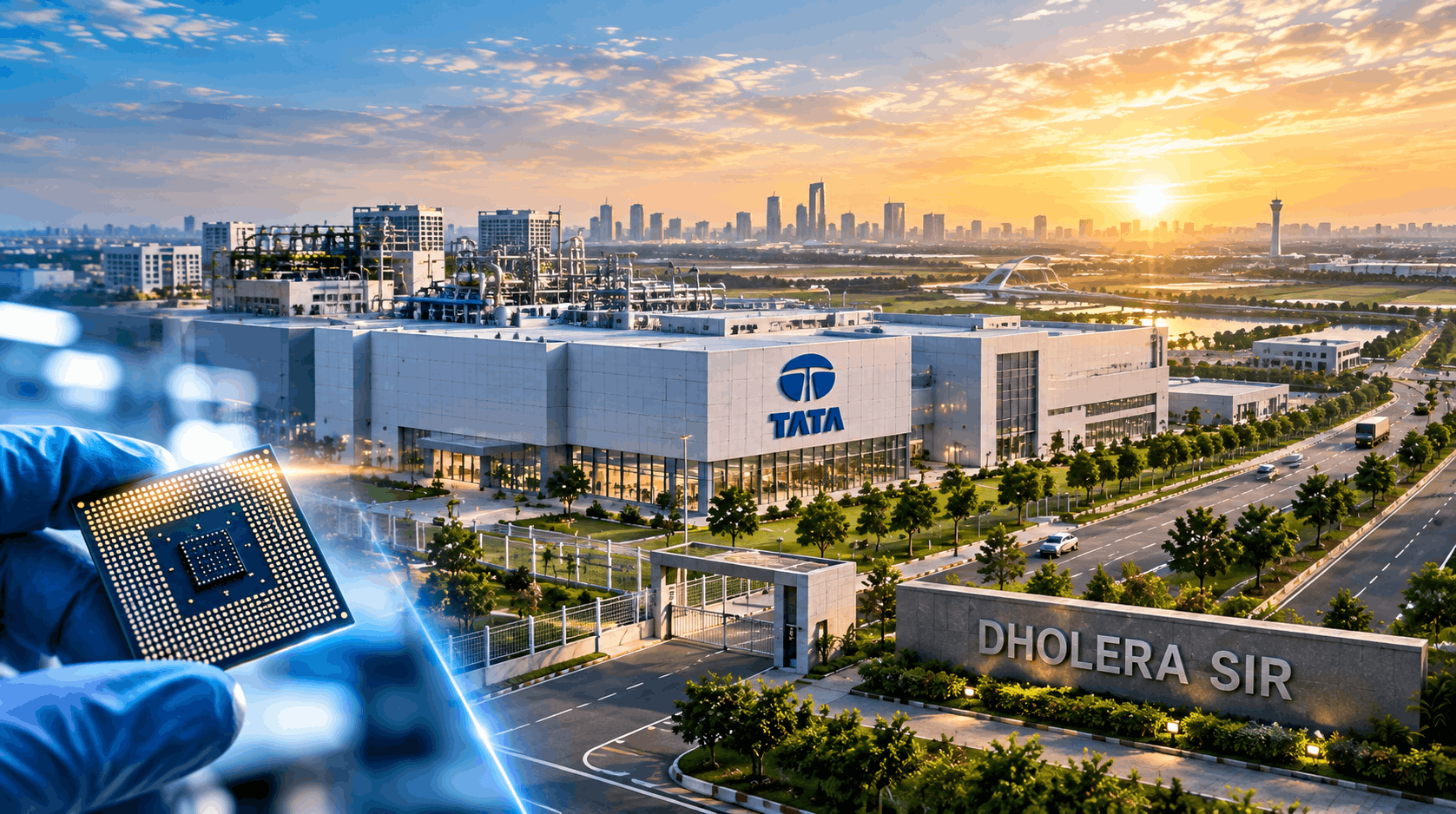
In the Netherlands, with Prime Minister Modi and Dutch Prime Minister Rob Jetten present, Tata Electronics and ASML signed a Memorandum of Understanding to build out India's first commercial 300mm semiconductor fabrication plant in Dholera, Gujarat.
Let's be precise about what this actually means.
ASML is not simply a supplier.
It is the company that makes the machines that make the chips the world runs on.
Without ASML's lithography tools, no semiconductor plant, not TSMC, not Samsung, nor Intel can manufacture at commercial scale.
The MoU commits ASML to supplying its advanced lithography systems to the Dholera fab, alongside training Indian engineers, developing local supply chains, and co-building R&D infrastructure.
The Dholera Fab What It Is
- India's first commercial 300mm (12-inch wafer) semiconductor fab
- Joint venture: Tata Electronics + Taiwan's Powerchip Semiconductor (PSMC)
- Total investment: approximately $11 billion (₹91,000 crore)
- Process nodes: 28nm, 40nm, 55nm, 90nm, and 110nm
- Target sectors: automotive, mobile devices, AI hardware, power electronics
- First chip production expected: December 2026
- Power: 100% green energy
- Water: 100 MLD from the Narmada River
- Formally notified as a Special Economic Zone: April 2026
A note of honest context:
The chips Dholera will produce are at 28nm to 110nm process nodes.
The cutting edge today is 2nm or 3nm.
But this doesn't diminish what's happening.
These mature nodes are exactly what automotive chips, industrial electronics, power management ICs, and satellite components rely on.
India is stepping into a real global supply gap.
3. The Money Behind the Momentum
Public infrastructure commitments are only meaningful when backed by budget allocations.
This year, they are.
In Gujarat's 2026–27 state budget, Finance Minister Kanubhai Desai allocated ₹610 crore specifically for trunk infrastructure development at Dholera SIR.
This covers:
- Power infrastructure
- Water utilities
- Logistics systems
- Internal road networks
At the national level, Union Budget 2026 included a ₹40,000 crore allocation toward semiconductor manufacturing and allied ecosystem development.
The Gujarat government has also announced a ₹15 crore investment in a dedicated security infrastructure grid for Dholera and Sanand.
This includes:
- AI-driven surveillance
- ANPR cameras
- Drone monitoring
- Digital labour management systems
- Rapid-response security units
4. What's Actually Being Built on the Ground
Beyond policy announcements, Dholera is moving toward physical reality.
Gujarat's Minister of State for Home, Harsh Sanghavi, recently reviewed progress within the activation zone.
The focus is now on civic infrastructure and livability.
Civic Infrastructure Nearing Completion
- Multi-specialty hospitals
- International-standard schools
- Fire stations
- Food courts
- Government guest houses
- Event tent cities
- 1,500 premium service apartments
- Residential townships
The 1,500 service apartments are particularly important.
They are being developed specifically for engineers, scientists, and technical experts working on the semiconductor project.
This signals that industrial activity is moving beyond announcements and into execution.
Senior executives from the Adani Group have also completed infrastructure reviews in the region, indicating interest in future utility and power-related opportunities.
5. An Honest Assessment for Investors
Dholera has faced skepticism over the years.
And some of that skepticism was understandable.
Large planned cities often take time.
But what is different today is the sequencing.
Infrastructure is arriving before large-scale occupancy.
That is exactly how successful industrial cities are built.
The semiconductor anchor project significantly changes Dholera's risk profile.
A ₹91,000 crore fab supported by global technology partnerships is not a project that can be easily abandoned.
It creates demand for:
- Housing
- Skilled labour
- Logistics
- Services
- Commercial infrastructure
- Ancillary industries
This chain reaction tends to become self-sustaining once it reaches critical mass.
At the same time, investors should remain realistic.
- Rail completion is expected around 2030–31
- The airport is still under development
- Full city-scale maturity will take years
Dholera offers early-stage entry along with the patience required for long-term wealth creation.
Why Dholera Matters More Than Ever
Dholera in 2026 is not Silicon Valley.
It is not Shanghai.
And it doesn't need to be.
What makes Dholera important is that it is India's most credible attempt at building a future industrial city from the ground up.
It now has:
- A semiconductor anchor project
- A Cabinet-approved rail corridor
- A high-speed expressway
- An international airport under development
- Dedicated government support
- Massive infrastructure investments
The question is no longer whether Dholera will happen.
The question is how quickly it scales and who is positioned before the next phase of growth begins.
Frequently Asked Questions
What is the Ahmedabad Dholera Rail Corridor?
It is a 134 km semi high-speed rail project approved by the Cabinet in May 2026 that will connect Ahmedabad with Dholera SIR and Dholera International Airport.
What is the Tata Semiconductor Project in Dholera?
It is India's first commercial semiconductor fabrication plant being developed by Tata Electronics and PSMC with an investment of approximately ₹91,000 crore.
When will the first chip be produced in Dholera?
According to official announcements, the first chip is expected to be produced by December 2026.
Why is Dholera important for investors?
Dholera combines industrial growth, airport infrastructure, expressway connectivity, rail development, and semiconductor manufacturing, making it one of India's most significant long-term growth corridors.
Is Dholera International Airport operational?
The airport is currently under development and moving through its operational preparation and trial phases.
What industries are expected to grow in Dholera?
Semiconductors, electronics manufacturing, logistics, renewable energy, AI infrastructure, data centers, industrial automation, and advanced manufacturing sectors.
Conclusion
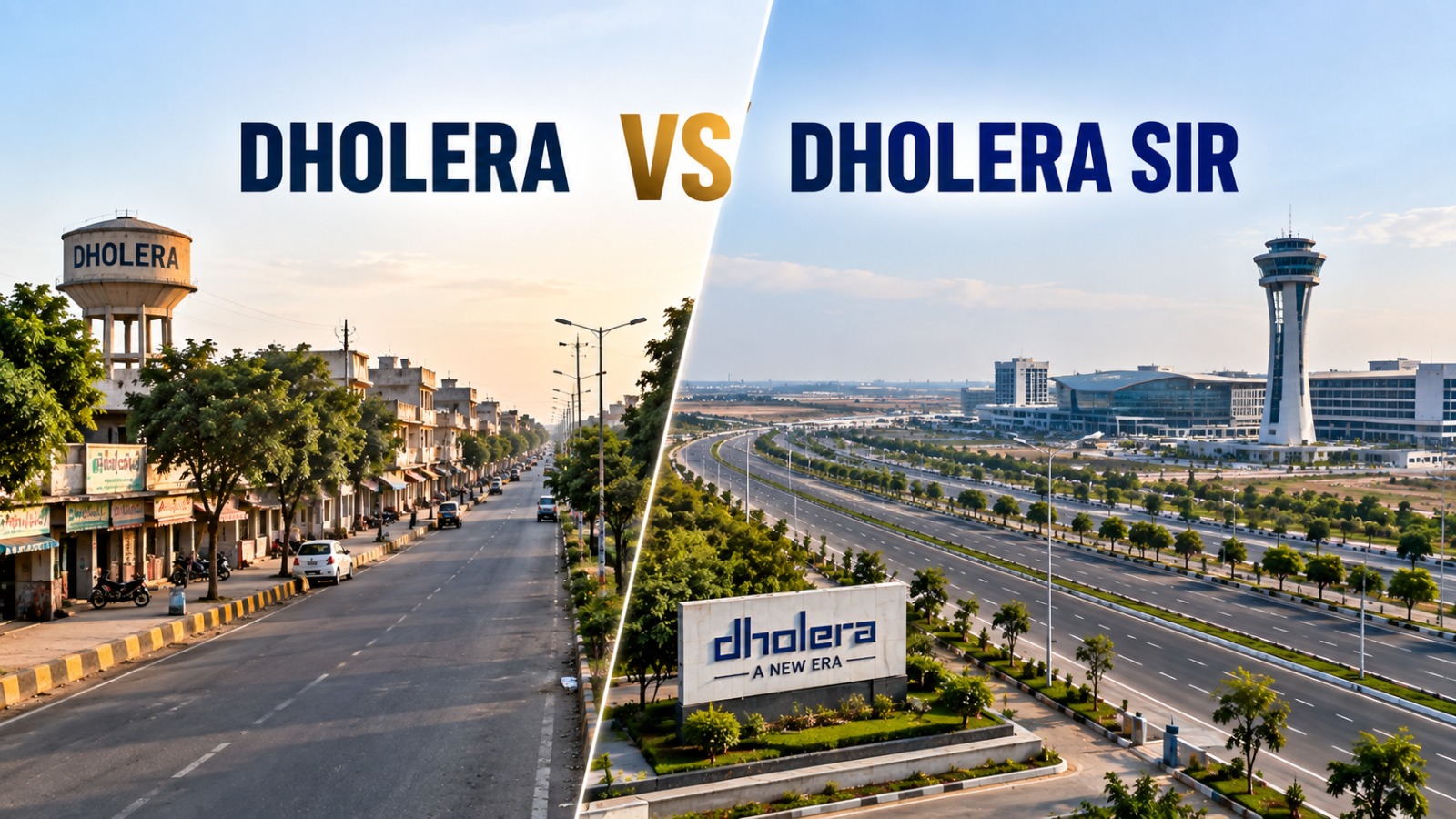
For years, Dholera was a future story.
Today, it is becoming a present reality.
The rail corridor has received approval.
The semiconductor ecosystem is taking shape.
The airport is moving toward operations.
Infrastructure spending continues to accelerate.
Taken individually, these developments are significant.
Together, they represent one of the most ambitious industrial transformation projects currently underway in India.
Looking to be part of Dholera's growth story?
Explore legally verified investment opportunities near Dholera Smart City with Eternal Group India.
Book your plot at Our Projects and discover premium investment opportunities positioned near one of India's fastest-growing smart city and industrial development corridors.