
Dholera SIR Latest News 2026: Airport, Expressway & Semiconductor
Dholera SIR Latest News 2026: Key Infrastructure & Development Updates
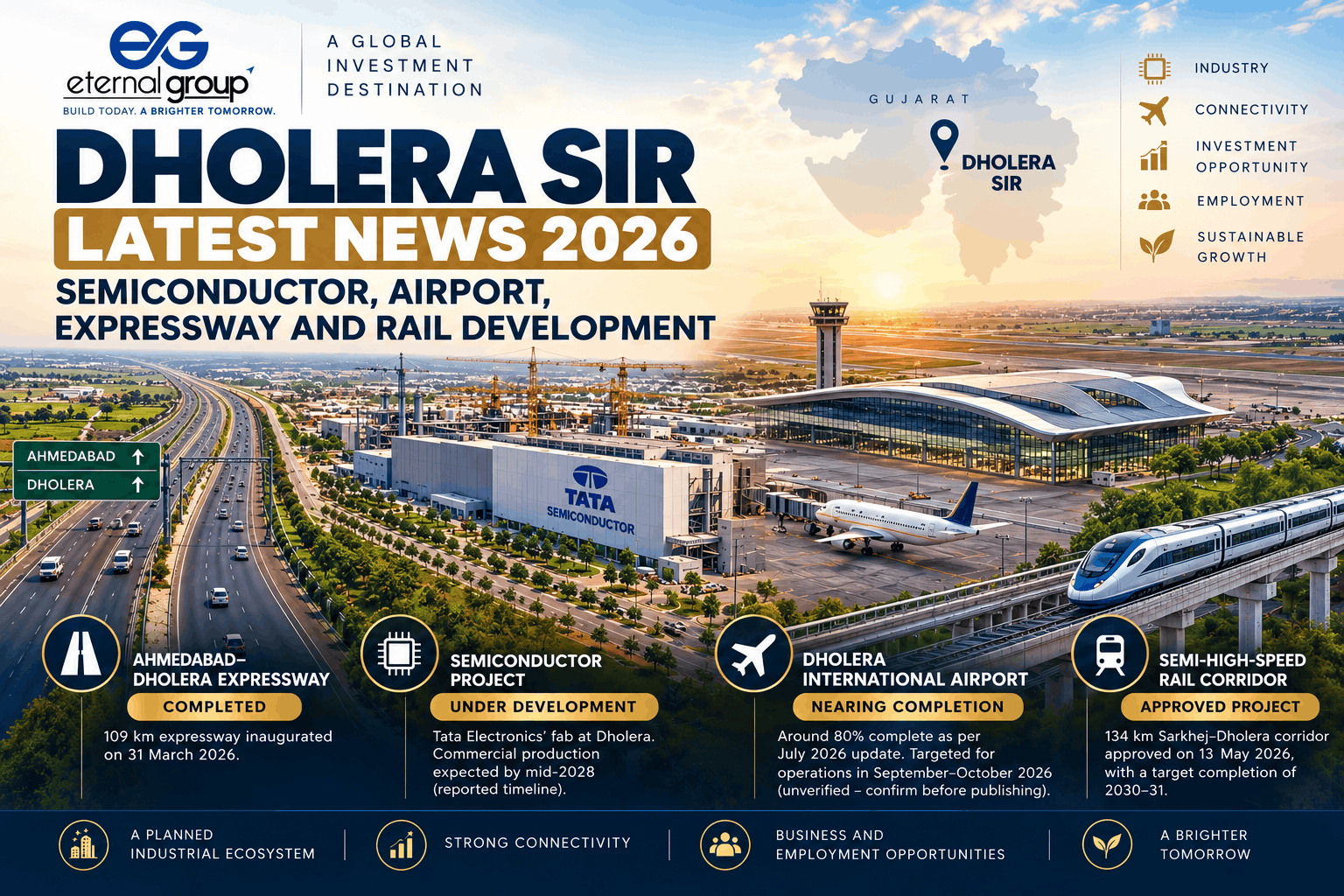
Dholera SIR Latest News 2026: Semiconductor, Airport, Expressway and Rail Development
Dholera Special Investment Region (SIR) in Gujarat is attracting attention because of its planned industrial ecosystem, major connectivity projects and India's semiconductor manufacturing ambitions. Several developments have moved forward during 2026, although not every announced project has reached operational status.
For investors, the important question is straightforward: what has been completed, what is under construction, and what remains a future target?
As of 12 October 2026, the Ahmedabad–Dholera Expressway is a major connectivity milestone, Tata Electronics' semiconductor fabrication plant remains under development, and the airport's previously announced October operational target requires fresh confirmation. A proposed semi-high-speed rail connection also forms part of the region's longer-term infrastructure plans.
Understanding these differences provides a more realistic picture of Dholera's development and its potential implications for industrial and real estate investment.
1. Dholera Semiconductor Project: India's Manufacturing Ambitions
One of the most significant developments associated with Dholera SIR is Tata Electronics' semiconductor fabrication project.
The Union Cabinet approved the project on 29 February 2024, with an investment of approximately ₹91,526 crore and a technology partnership involving Taiwan's Powerchip Semiconductor Manufacturing Corporation (PSMC). The project is intended to establish semiconductor wafer fabrication capacity in India.
On 16 April 2026, the Ministry of Commerce and Industry announced the notification of a 66.166-hectare Special Economic Zone for Tata Semiconductor Manufacturing Private Limited at Dholera. The government release stated that the zone was designed to support electronic hardware, software and IT-enabled services, with a projected employment potential of 21,000 people.
In a further development, the Press Information Bureau published a backgrounder on 28 September 2026 explaining how Dholera's semiconductor ambitions depend on a broader ecosystem that includes housing, healthcare, education, commercial facilities and other supporting infrastructure.
A report published on 5 October 2026 indicated that commercial production at the semiconductor fab is now expected around mid-2028. This should be treated as a reported timeline rather than proof that the plant is already operational.
Why it matters for real estate: A manufacturing facility of this scale can create demand for industrial suppliers, logistics, business services and supporting infrastructure as operations develop. However, the actual impact on surrounding property prices will depend on project execution, employment creation, land-use permissions and local market demand.
2. Dholera International Airport: Construction Progress and Operational Status
Dholera International Airport is another important component of the region's planned connectivity network.
On 14 July 2026, the Ministry of Civil Aviation reported that the airport was approximately 80% complete. According to the ministry's review, runway, taxiway and air traffic control ancillary works had been completed, while the passenger terminal was approximately 75% complete.
The minister also indicated that the government was targeting operationalisation within the following three months, subject to completion of the remaining work and necessary licensing.
That announcement made September–October 2026 an important period to watch. However, an announced target does not establish that commercial flight operations have commenced.
As of 12 October 2026, a subsequent official announcement confirming commercial operations could not be verified for this update. The current operational status should therefore be checked with the Airports Authority of India or the Ministry of Civil Aviation before publication of any claim that the airport is open.
Why it matters for investors: Airport connectivity could improve regional accessibility and support business travel and cargo movement over time. Yet the benefits for an individual land parcel will depend on its actual location, road access, approved land use and the eventual availability of airport services.
Investors should distinguish between an airport under construction and a fully operational airport when evaluating development timelines.
3. Ahmedabad–Dholera Expressway: A Major Connectivity Milestone
Road connectivity is central to Dholera's industrial development strategy.
The Ahmedabad–Dholera Expressway, approximately 109 kilometres long, was inaugurated on 31 March 2026. The route is intended to improve connectivity between Ahmedabad and the Dholera region, supporting the movement of people and goods.
For an emerging industrial destination, road infrastructure can influence transport costs, supplier access and the practical accessibility of industrial facilities. It can also make site visits and regional travel more convenient.
Still, an expressway's benefits should not be confused with guaranteed property appreciation. A parcel's connectivity depends on its distance from usable interchanges, the condition of approach roads and whether direct access is legally permitted.
For buyers evaluating land around Dholera SIR, the relevant question is not simply whether the expressway exists. It is how the particular property connects to the wider road network.
This distinction is especially important when comparing agricultural land, residential plots and parcels within designated development areas.
4. Ahmedabad–Dholera Semi-High-Speed Rail: The Longer-Term Plan
Rail connectivity is another part of Dholera's proposed multi-modal transport network.
The Union Cabinet approved the approximately 134-kilometre Sarkhej–Dholera semi-high-speed rail corridor on 13 May 2026. The project has a reported completion timeline of 2030–31.
If implemented as planned, the corridor could strengthen passenger connectivity between Ahmedabad and Dholera and support access to the developing industrial region.
However, approval is only one stage in a large infrastructure project. Construction, commissioning and passenger services must follow before the corridor can deliver its intended transport benefits.
This matters when evaluating property investments today. A rail connection with a completion target several years away should be considered a future infrastructure prospect, not an existing travel option.
Investors should also check whether a particular property has a practical and documented connection to the planned stations. General proximity to a proposed railway corridor does not automatically establish that a parcel will benefit commercially.
5. What These Developments Mean for Dholera Real Estate
The semiconductor project, expressway, airport and proposed rail corridor represent different stages of Dholera's development. Together, they help explain why the region attracts interest from industrial businesses and real estate investors.
Yet each development affects property demand differently.
The semiconductor project is relevant to manufacturing, suppliers and the supporting business ecosystem. The expressway provides an existing connectivity milestone. The airport's operational status must be verified against current official records, while the rail corridor remains a longer-term infrastructure project.
These distinctions should inform any investment decision.
Before purchasing land, investors should verify the property's title, ownership history, land-use classification, applicable approvals, development permissions and access rights. They should also examine the actual location rather than relying solely on a project's proximity to a major infrastructure announcement.
A property's investment case should stand on documented legal status, realistic demand assumptions and an appropriate holding period—not on an expectation that every proposed development will immediately raise land values.
For real estate businesses, transparent communication is equally important. Clearly identifying completed infrastructure, projects under construction and future targets helps prospective buyers assess opportunities without confusing plans with present-day facilities.
Conclusion: Track Progress, Not Just Announcements
Dholera SIR's development in 2026 is being shaped by a combination of industrial investment and infrastructure expansion. The operational expressway, Tata Electronics' semiconductor project, airport development and approved rail corridor each contribute to a different part of the region's long-term growth story.
The next important milestones will be verified progress toward semiconductor production, confirmation of airport operations and subsequent implementation stages for the rail corridor.
For investors, the clearest takeaway is to evaluate Dholera through evidence: completed infrastructure, documented approvals, actual connectivity and the legal status of the specific property under consideration.
Call to action: Explore Eternal Group's Dholera SIR real estate opportunities and request a detailed consultation to understand project locations, applicable approvals and property-specific investment considerations.
Sources and References
-
Press Information Bureau, Ministry of Commerce & Industry — Government Notifies India's First Chip Fabrication Plant at SEZ Dholera, 16 April 2026.
-
Press Information Bureau, Prime Minister's Office — Agreement Between ASML and Tata Electronics for Semiconductor Manufacturing, 16 May 2026.
-
Press Information Bureau, Ministry of Civil Aviation — Union Civil Aviation Minister Reviews Progress of Dholera International Airport, 14 July 2026.
-
Press Information Bureau — Beyond the Fab: How Dholera Is Building the Ecosystem Around India's Semiconductor Ambition, 28 September 2026.
-
Dholera News — Tata Dholera Fab's Commercial Production Pushed to Mid-2028, 5 October 2026.
Editorial note: The airport's current operational status and the latest implementation status of the expressway and rail corridor should be checked against the relevant official authorities before publication. Infrastructure targets and reported timelines are not guarantees of completion or investment returns.
Recent News


Dholera Revenue Growth: Accenture FY2027 Outlook

Dholera: NX Group Targets $380 Million Revenue as...