
Dholera Revenue Growth: Accenture FY2027 Outlook
Accenture’s FY2027 Revenue Growth and What It Means for Dholera
Accenture’s FY2027 Outlook Signals Continued IT Demand
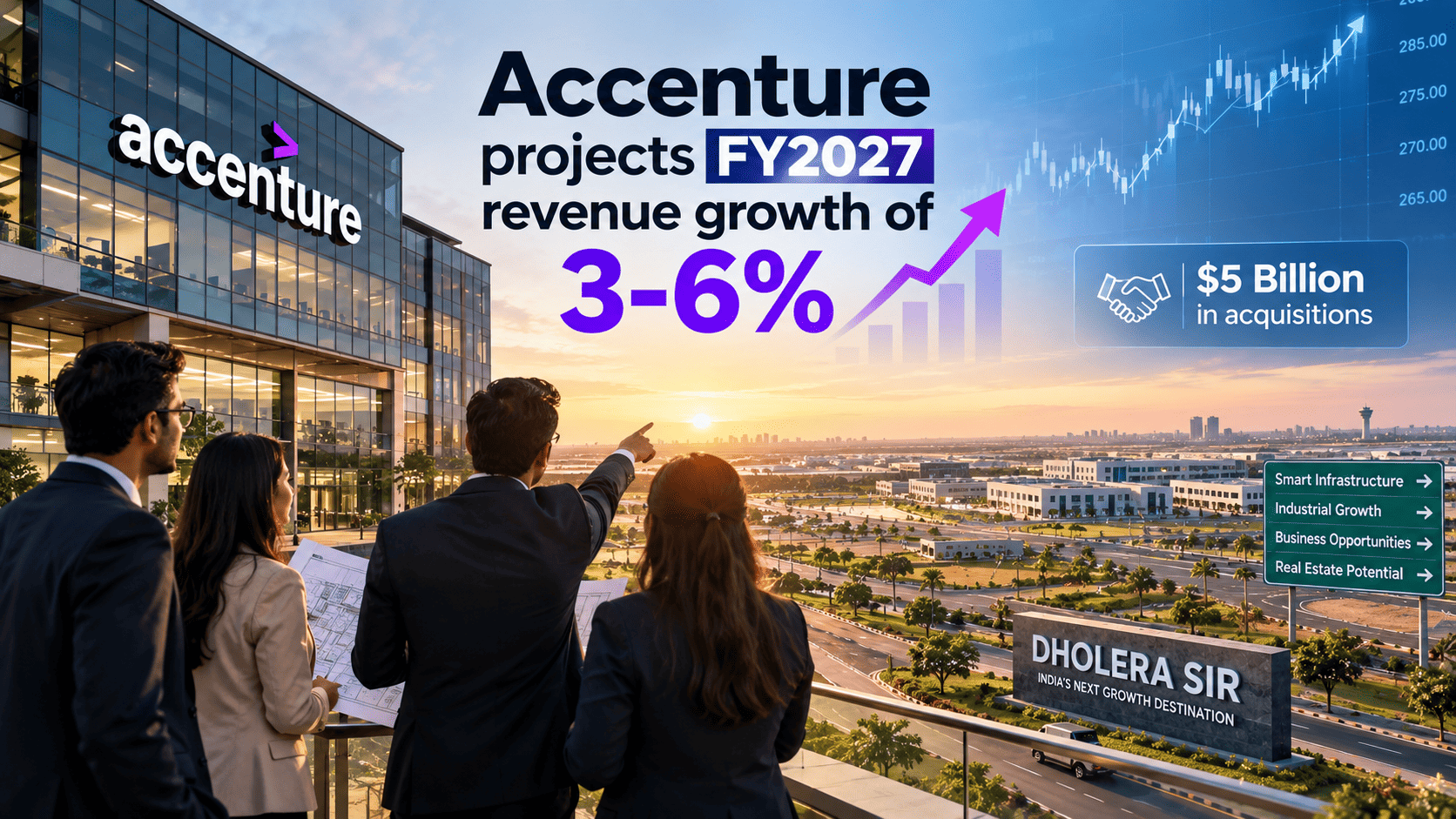
Accenture has projected 3–6% revenue growth for FY2027, a range reported as being above analyst expectations. The company also announced plans for approximately $5 billion in acquisitions, sending its shares sharply higher and lifting several IT-services peers.
For someone tracking Dholera, Dholera SIR, and the Dholera Smart City, the announcement is relevant for a broader reason: digital services are becoming increasingly important to modern industrial regions. However, Accenture's guidance is a company-wide forecast; it should not be treated as a direct revenue forecast for Dholera.
Why Accenture’s Revenue Outlook Matters
Revenue growth is one of the simplest ways to understand whether a large technology company expects demand for its services to expand or contract.
Accenture’s 3–6% FY2027 revenue growth projection provides a useful signal about the company’s expectations for technology-services demand. Its planned acquisitions of around $5 billion also point to continued investment in capabilities and markets.
For the wider Indian technology ecosystem, such developments matter because industrial projects increasingly require software, cloud systems, cybersecurity, data management and automation.
That connection becomes interesting when looking at Dholera development.
What Does This Mean for Dholera?
The Dholera city project is being developed as a planned industrial and economic region. Its long-term development involves more than physical infrastructure. Businesses operating in such an environment can require digital systems to manage production, logistics, energy, communications and other operations.
This creates a possible link between real estate Dholera and India's expanding technology economy.
Still, the distinction is important. Accenture's announcement does not confirm an investment, office, project or revenue commitment in Dholera SIR. Any such connection would need separate confirmation.
For real estate investors, the more useful question is how a growing technology and industrial ecosystem can influence demand for commercial spaces, housing and supporting services over time.
Dholera Smart City and the Digital Economy
A modern industrial region needs both physical and digital infrastructure.
The Dholera Smart City concept combines planned infrastructure with industrial development. As companies establish operations, technology can become part of everyday business activity—from automated manufacturing systems to logistics tracking and enterprise software.
This is where Accenture's revenue outlook provides wider context rather than a direct Dholera forecast.
If technology-services demand continues to grow, industrial regions such as Dholera may benefit from the broader ecosystem surrounding digital manufacturing and business services. The actual impact, however, will depend on company investment decisions, employment growth and business occupancy.
What Real Estate Investors Should Watch
For anyone evaluating real estate, the Accenture announcement should be viewed as one small data point rather than a reason by itself to buy property.
The stronger indicators to monitor around Dholera development are actual industrial occupancy, infrastructure completion, company investments, employment creation and demand for residential and commercial property.
These factors can provide a clearer picture of whether the Dholera city project is developing from an infrastructure plan into an active economic centre.
Our Projects in and Around Dholera SIR
If you are watching Dholera for the reasons above, these are the plots you can actually enter today. Four sit inside or within minutes of the Dholera SIR investment corridor, and one is in Indore for investors who prefer to spread across two markets.
- Eterno City — Jhinjar, Dholera: 100% NA approved, NOC cleared and title clear residential plots roughly 10 minutes from Dholera SIR, 15 minutes from the Knowledge & IT Zone and the expressway, and 25 minutes from Dholera International Airport.
- Eterno Royal — Velavadar, Kanatalav, near Dholera SIR: a planned residential plotted development for investors, NRIs and future homeowners who want land directly in the path of Dholera’s industrial and semiconductor growth.
- Nestoria Atulyam — Dhanala, inside Dholera SIR: 19,324 sq. metres of Non-Agricultural land offering gated 3 BHK luxury villas alongside residential plots, all with clear titles and approved layouts.
- Orchid Villa Paradise — Kharad, Dholera: a premium residential plotting project beside Dholera’s 230-feet-wide road infrastructure and sensor-based smart city planning.
- Sai Kripa — AB Road, near Patel Motors and Omaxe City, Indore: our one project outside Gujarat, and a RERA-approved commercial and residential plotting project on a proposed 75-metre main road with a commercial mall in front.
Compare them side by side on our ongoing projects page, or use the plot size and price calculator to work out what a specific plot will cost you.
The Key Takeaway
Accenture's projected 3–6% FY2027 revenue growth and planned $5 billion acquisition programme indicate continued confidence in its business outlook. The announcement does not directly establish a Dholera investment, but it offers useful context for understanding the wider technology economy.
For those following Dholera, Dholera SIR, Dholera Smart City and real estate Dholera, the practical takeaway is simple: watch actual business activity and infrastructure progress alongside broader technology-sector signals.
Recent News

Dholera SIR Latest News 2026: Airport, Expressway...


Dholera: NX Group Targets $380 Million Revenue as...